
Do You Need to Be Fit to Become a Personal Trainer? Honest Answer
A question that stops a lot of people before they even start: "Do I need to be super fit to become a personal trainer?"
It's one of the biggest mental barriers to entering the fitness industry. It comes from a mix of imposter syndrome, social media distortion, and genuine practical concerns.
So let's tackle it directly.
The short answer: You need to be fit enough to demonstrate exercises safely, pass practical assessments, and model healthy behaviour. You don't need to be a CrossFit athlete or Instagram fitness model.
The real answer: It's more nuanced than that, and understanding the nuance might be exactly what you need to hear.
What "Fit Enough" Actually Means
When we talk about being "fit enough" to become a personal trainer, here's what that means:
Functional movement competency.
You need to perform and demonstrate fundamental exercises with good form:
Bodyweight squats
Lunges (forward, reverse, lateral)
Press-ups (or modified versions)
Planks and core stability exercises
Basic resistance exercises (dumbbell presses, rows, etc.)
Notice what's not on that list: Olympic lifts, advanced gymnastics, marathon running, or anything requiring elite athleticism.
Cardiovascular baseline.
You need enough aerobic fitness to:
Walk clients through a gym session without getting out of breath
Demonstrate interval exercises (showing a client how to do burpees or mountain climbers)
Keep pace during a practical workshop
You don't need to run 10k or cycle for hours. You just need to be active enough to lead a session confidently.
Physical stamina for teaching.
Personal training is physically demanding, not because you're lifting heavy weights yourself, but because you're on your feet for hours, demonstrating movements, spotting clients, and staying energised.
If you can comfortably walk for 30-60 minutes, go up and down stairs without exhaustion, and move around a gym for a few hours, you're in the ballpark.
Injury-free movement.
You don't need to be a peak athlete, but you do need to be free from injuries or limitations that would prevent you from safely demonstrating common exercises.
If you have chronic pain, mobility restrictions, or recent injuries, address those before or during your training. Many PT students actually improve their own fitness while completing their qualification.
What "Fit" Doesn't Mean
What you don't need to be:
Lean or muscular (aesthetics don't equal competence)
Strong by powerlifting standards (you're coaching, not competing)
Athletic in a traditional sense (former athletes aren't better PTs by default)
Young (fitness isn't age-dependent)
A gym regular (you can build fitness during your PT training)
Some of the best personal trainers don't look like fitness models. And some of the worst trainers do.
Why? Because coaching ability, empathy, programme design, and communication skills matter more than your body composition.
The Social Media Distortion
One reason people worry about not being "fit enough" is the fitness industry's social media presence.
Instagram, TikTok, YouTube are dominated by:
Bodybuilders with single-digit body fat percentages
CrossFit athletes doing handstand push-ups
Influencers with six-packs and brand deals
That's great for marketing protein powder. It's terrible for representing what actual, working personal trainers look like.
Most successful PTs are normal-looking people who help normal-looking clients achieve realistic goals.
If you're a 38-year-old parent trying to lose a bit of weight and get stronger, who are you more likely to trust? A 22-year-old Instagram model who's never had an office job or struggled with their weight, or a 40-year-old ex-teacher who's navigated career change stress, parenthood, and getting back into fitness?
That's the advantage of not being a stereotypical fitness influencer.
Practical Assessments: What You'll Actually Need to Do
During a Level 3 Personal Trainer course (look for one that's Ofqual-regulated and CIMSPA-recognised), you'll face practical assessments.
Exercise demonstration.
You'll be asked to demonstrate common exercises with correct form and technique. This includes:
Bodyweight movements (squats, lunges, planks)
Resistance exercises (dumbbell presses, rows, deadlifts with light-moderate weight)
Cardiovascular movements (demonstrating how to use a treadmill, rower, or perform interval exercises)
Fitness requirement: moderate. You need to perform these movements correctly, but you're not being judged on how much you lift or how fast you move. Form and coaching cues matter more.
Mock client session.
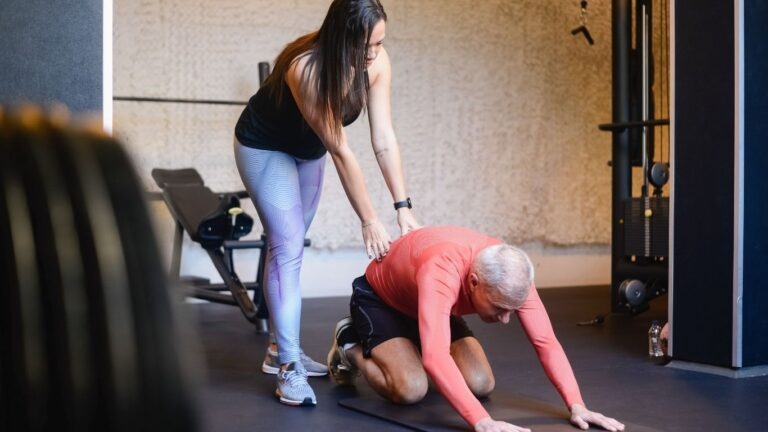
You'll coach a mock client (often a fellow student or assessor) through a workout. Your job:
Assess their movement quality
Provide clear instructions and corrections
Adapt exercises to their ability
Communicate effectively
Fitness requirement: low to moderate. You're coaching, not performing. The focus is on your ability to guide, correct, and communicate.
Programme design.
You'll create exercise programmes for hypothetical clients with different goals, abilities, and limitations.
Fitness requirement: zero. This is about knowledge, not physical ability.
Reality check:
If you're currently sedentary, you'll struggle with practical assessments. But if you're moderately active (walking regularly, doing some strength or cardio work, moving your body most days), you'll be fine.
Most PT courses run over several months, giving you time to build your own fitness as you learn.
At Bucks PT Academy, these practical assessments take place at Anytime Fitness Loudwater — a fully equipped commercial gym, not a hired conference room.
Building Your Fitness During Your PT Training
One of the best-kept secrets of PT training? Many students improve their own fitness significantly during their course.
Why?
You're learning exercise science, so you apply it to yourself
You're practicing movements regularly (theory becomes practice)
You're in gym environments frequently (easier to train when you're already there)
You're motivated by the process (studying something makes you engage with it)
If you start your PT course at a moderate fitness level, you'll likely finish at a much higher level. The course itself is a fitness journey.
Where to start (if you're currently inactive):
If you're thinking, "I'm not fit at all right now," here's a realistic 8-12 week prep plan before starting a PT course:
Weeks 1-4: Build the habit
Walk 20-30 minutes, 4-5 days per week
Bodyweight squats, lunges, press-ups (modified if needed), planks - 2-3 times per week
Focus on consistency, not intensity
Weeks 5-8: Increase load
Extend walks to 30-45 minutes
Add light dumbbells or resistance bands to bodyweight exercises
Introduce basic cardio intervals (brisk walk for 2 mins, easy pace for 2 mins, repeat)
Weeks 9-12: Movement competency
Start lifting light-moderate weights (goblet squats, dumbbell presses, rows)
Practice full-body movements (deadlifts with light weight, step-ups, etc.)
Work on core stability (planks, dead bugs, bird dogs)
By the end of 12 weeks, you'll be fit enough to start a PT course confidently.
The Bigger Picture: Fitness vs. Coaching Ability
You can be shredded, strong, and fast, and still be a terrible coach if you:
Can't listen to clients
Don't understand programming beyond "do what I do"
Lack empathy for people who struggle
Can't adapt exercises for injuries or limitations
Don't understand behaviour change psychology
Conversely, you can be a great personal trainer with a "normal" body and moderate fitness if you:
Genuinely care about helping people
Communicate clearly and patiently
Design smart, progressive programmes
Build trust and rapport
Understand that fitness is about the client, not you
Clients hire personal trainers to help them reach their goals. They're not hiring you to perform. They're hiring you to coach, guide, support, and problem-solve.
What Clients Actually Care About
When someone hires a personal trainer, here's what they're thinking:
1. Can this person help me reach my goal?
2. Do I trust them?
3. Will they understand my challenges?
4. Do they make me feel comfortable and supported?
Notice what's missing? "Are they ripped?"
Some clients prefer trainers who "look the part." But many clients (especially those over 35, those with injuries, or those new to fitness) actively prefer trainers who don't look like fitness influencers. When choosing a PT course, check the awarding body behind the qualification. Providers accredited through bodies like Focus Awards carry nationally recognised credentials that employers and insurers accept.
Why? Because they find them more relatable, more empathetic, and less intimidating.
The Confidence Paradox
The people who worry most about not being fit enough are often the ones who'll make the best trainers.
Why? Because they have empathy. They understand struggle. They know what it's like to feel self-conscious, to lack confidence, to face setbacks.
The stereotypical "naturally athletic" trainer often struggles to relate to clients who've never been sporty. They can't understand why someone finds a press-up so hard, or why losing weight feels impossible, or why stepping into a gym is terrifying.
If you've experienced those things, you get it. And that matters.
The Bottom Line: Should You Go For It?
If you're thinking, "I'm interested in becoming a PT, but I'm not sure I'm fit enough," here's the test:
Can you walk for 30 minutes comfortably?
Can you perform basic bodyweight movements (squat, lunge, plank) with reasonable form?
Are you injury-free or managing any limitations well?
Are you willing to build your own fitness during your training?
If you answered yes to those, you're fit enough to start.
If you're not quite there yet, spend 8-12 weeks building a base, then go for it.
Thinking About It? Let's Talk
If you're based in Buckinghamshire and want honest advice about whether your current fitness level is enough to start a PT qualification, we can chat.
Contact Bucks PT Academy:
We work with students at all fitness levels. Some are ex-athletes. Some are career changers who've been sedentary for years. What they have in common: a genuine desire to help people and a willingness to learn.
If that's you, fitness level is just a detail, and it's one you can improve as you go.
Related Reading
Take the Next Step
Ready to explore personal training as a career? Download our free prospectus to learn about our Ofqual-regulated, CIMSPA-recognised Level 3 Diploma - including course structure, career outcomes, and how to get started.
👉 Request Your Free Prospectus
Already know this is for you? Book a 15-Minute Call or Message Us on WhatsApp to discuss your options.